With great joy, we close one stage and open the door to a new collective cycle. We share the virtual gathering that served as a hinge between the balance of the previous campaign and the launch of the new proposal for the 2026–2027 period. This participatory breeding space continues to grow thanks to the commitment and work of a community dedicated to a fairer, more sustainable, and diverse seed system.
The fruits of collective effort
During the campaign we leave behind, the network dedicated itself to the careful observation and recording of three varieties with very distinctive identities and traits: the creole tomato No me olvides, the Platense tomato from the Carcione population, and the promising Cherry 113, which represents the first material to carry the Bioleft registration. The journey brought us valuable learnings regarding germination capacity, agroecological pest management, and appropriate isolation techniques that allow preserving the purity of each variety across different scales of production.
Because Bioleft is an initiative oriented toward open science and the construction of distributed knowledge, today we celebrate that the data collected during these four years of collective work are now consolidated and freely available in our open dataset, accessible to the entire community for consultation and reuse. (See here).
One of the most exciting milestones of this cycle was holding tastings in shared spaces such as the Universidad Nacional de San Martín. In these tests, participants evaluated the tomatoes, comparing them with samples purchased at local greengrocers. The results conclusively confirmed that the creole varieties far outperformed commercial controls in aroma, texture, balance between sweetness and acidity, and overall flavor, demonstrating that the standardized appearance on supermarket shelves often hides an alarming loss of quality and biodiversity.
Heading toward a new cherry campaign
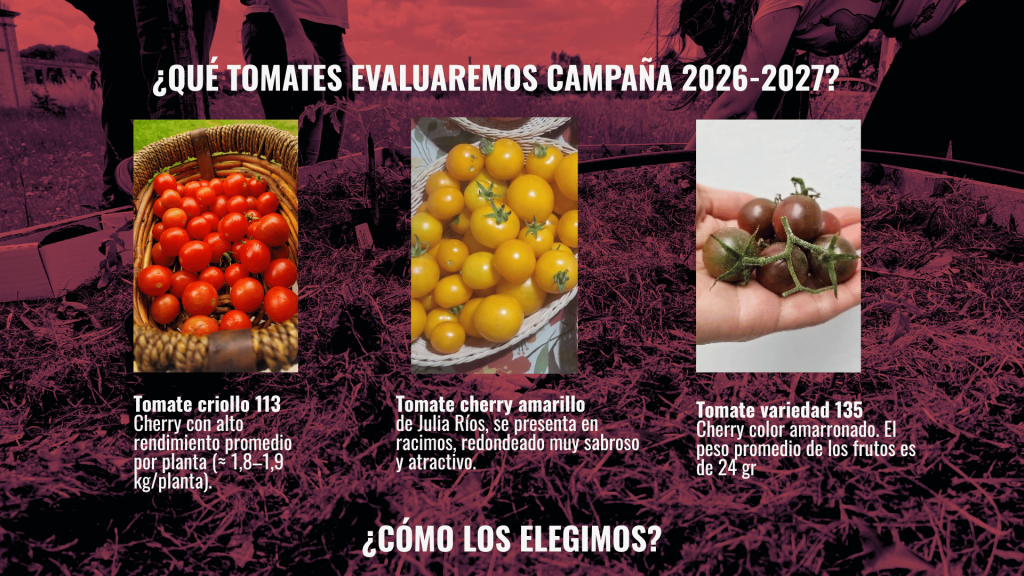
For the upcoming season, the network's proposal will focus on three cherry-type varieties. It is important to emphasize that the community itself led the choice of tomatoes to work with based on their evaluations:
- We will continue working with Cherry 113, which was highly rated in the tasting and is currently in the registration process, taking on the challenge and excitement of choosing its final name in a participatory, community-driven manner.
- In addition, we are adding the Cherry Amarillo (Yellow Cherry), a seed stewarded and multiplied by Julia Ríos, farmer-breeder from Bioleft. This variety was highly valued in the UNSAM tasting and stands out for its high productivity, persistent sweetness through the end of the cycle, and high agronomic hardiness.
- Joining these materials is Cherry 135, which was highly appreciated during the tasting at FAUBA for its outstanding flavor
How to join and participate in the process
This network is built upon core pillars of commitment to the project, farming experience, and the willingness to document plant performance so that the generated information remains open and collectively accessible. Those who take on this role receive a welcome kit with detailed technical guides, access to record sheets, and a direct channel for daily exchange to resolve doubts, share recipes, and build ties within local communities.
The call for evaluators for this campaign closed on July 17, initiating the selection stage and the subsequent distribution of seed kits through in-person pickup points and the planned shipping system. Nonetheless, we invite the entire community to explore our seed exchange platform, a collectively designed tool aimed at helping heritage and local varieties circulate freely from hand to hand, enabling those who are not part of this formal evaluation to also join in sowing diversity.